Custom tissue paper prints best from clean vector logo artwork, a repeat layout chosen for how the sheet gets folded, and colors checked against the tissue shade underneath. Get Custom Tissue Paper turns whatever file you have into a free mockup within 24 hours, so you can approve layout, color and scale before anything prints or you pay.
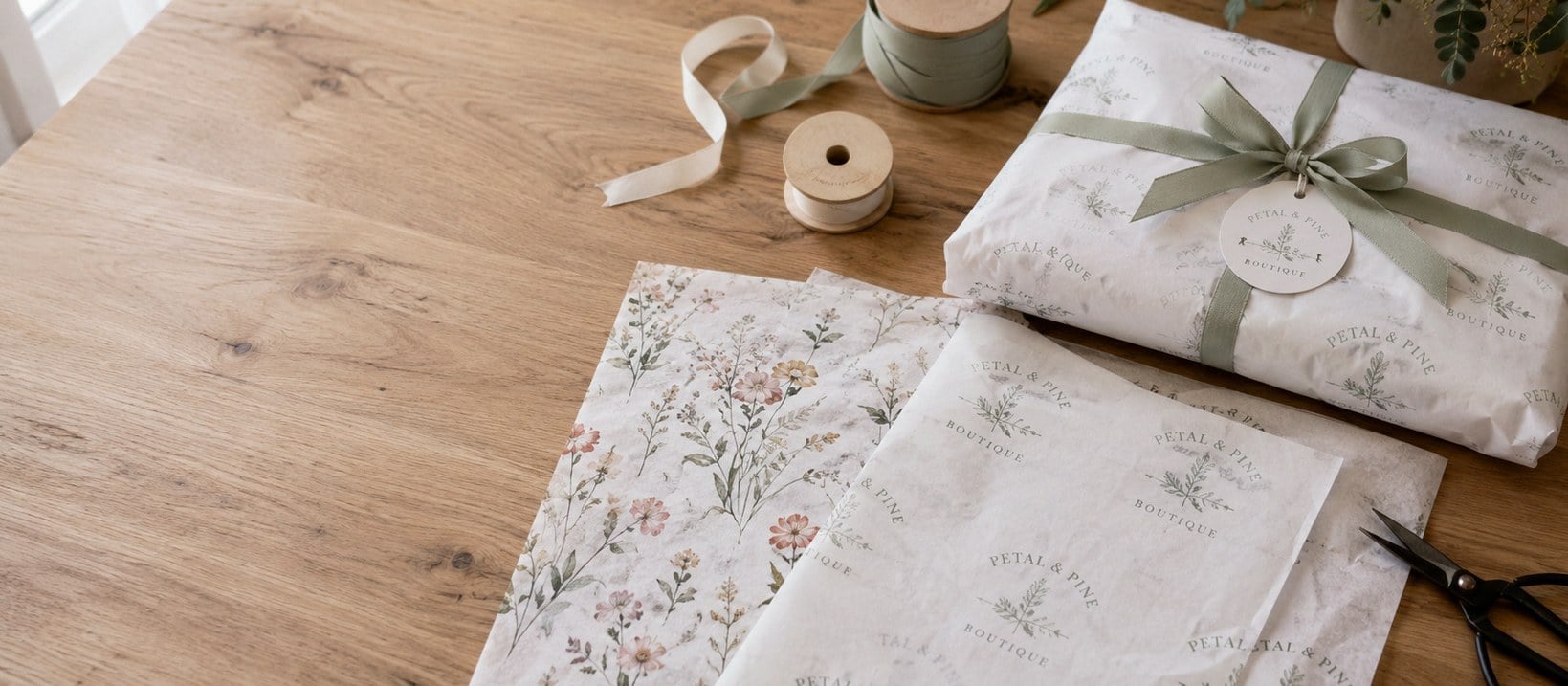
- Vector logo files (AI, EPS, SVG or vector PDF) give the sharpest edges on thin tissue paper.
- Repeat layouts keep the logo visible no matter how the sheet is folded or crumpled.
- Ink color shifts on colored tissue, so the mockup shows your logo on the actual sheet shade.
- Free mockup within 24 hours, unlimited free revisions, and nothing to pay until you approve.
- Minimum order of 12 with standard turnaround of about 2 weeks after approval.
What kind of logo file works best for custom tissue paper?
A vector logo file works best for custom tissue paper because vector artwork stays perfectly sharp at any size, and tissue paper is a thin, slightly absorbent sheet that softens fine detail. Formats such as AI, EPS, SVG or a PDF exported from design software keep every curve and letter edge as clean lines rather than pixels.
A raster file such as a JPG or PNG can still work when it is large and crisp, but a small logo pulled from a website or social profile usually looks fuzzy once it is scaled up across a sheet. If a raster file is all you have, send it anyway. Get Custom Tissue Paper reviews every upload and will tell you on the mockup whether the logo needs to be redrawn or cleaned up before printing.
- Best: the original vector file from whoever designed your logo.
- Good: a high-resolution PNG with a transparent background.
- Workable: a sharp screenshot or photo, flagged for cleanup on the mockup.
- Avoid: logos with a white box baked in around them, which print as a visible rectangle on colored tissue.
Should my tissue paper design be a repeat pattern or a single logo?
Most custom tissue paper is printed as a repeat pattern, where the logo or motif tiles across the whole sheet, because tissue paper is folded, scrunched and tucked in ways a single centered logo cannot survive. With a repeat, the brand mark shows up on every visible fold, whether the sheet is draped over a sweater or stuffed around a candle.
A single large logo can work for flat, presentation-style wrapping where the sheet lies smooth across the top of a box. Choose the layout based on how your team actually wraps, not how the flat artwork looks on screen.
| Layout | How it looks | Best for |
|---|---|---|
| Tight logo repeat | Small logos close together across the sheet | Crumpled fill, gift bags, small items |
| Open logo repeat | Logos spaced out with more plain tissue between | Folded wraps in apparel and boutique boxes |
| Offset or brick repeat | Every other row shifted for a woven look | Brands that want the sheet to read as a pattern |
| Full-coverage pattern | Artwork or illustration fills the whole sheet | Statement unboxing and seasonal designs |
| Single centered logo | One mark in the middle of the sheet | Flat lids and presentation boxes |
For an all-over illustrated look, see full-coverage pattern tissue; for a classic tiled mark, see logo print tissue paper.
How do brand colors print on colored or white tissue paper?
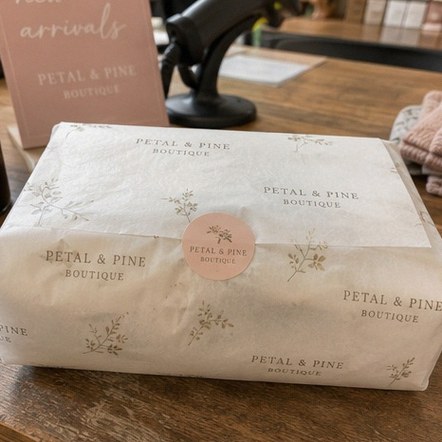
Brand colors print most faithfully on white custom tissue paper, because the sheet does not tint the ink. On colored tissue paper, the shade of the sheet shows through and shifts the ink: a light ink on a dark sheet can nearly disappear, and a blue logo on yellow tissue can drift toward green.
That is why the pairing of ink and sheet matters as much as the logo itself. High contrast reads clearly from across a room and in unboxing photos, while a tone-on-tone combination, such as a slightly darker ink on a soft blush sheet, gives a quieter, more upscale feel.
- Share brand color codes (Pantone, HEX or CMYK) if you have them, so the match starts from your standard.
- Expect screens to show colors brighter than ink on tissue; judge the mockup for contrast and balance, not exact glow.
- For metallic effects, ask about metallic foil tissue paper rather than trying to imitate shine with a flat gold ink.
- Browse sheet shades on the custom colored tissue paper page before choosing the ink.
Get Custom Tissue Paper places your logo on the actual sheet color in the mockup, so you can compare combinations side by side and request changes for free.
How much detail can custom tissue paper actually hold?
Custom tissue paper holds bold shapes, solid fills and confident lettering well, but very fine detail tends to soften because the thin sheet absorbs a little ink at every edge. Hairline strokes, tiny taglines, small reversed-out text and delicate gradients are the elements most likely to blur or break up.
The fix is usually simplification rather than a different printer. Many brands keep a secondary or simplified version of their logo, such as an icon, monogram or wordmark without the tagline, and that version almost always prints more cleanly in a repeat than the full lockup.
- Drop the tagline or website from the repeat unit unless it is large enough to read comfortably.
- Thicken very thin lines slightly so they survive on the sheet.
- Replace soft gradients with solid colors or a two-tone version.
- Use an icon or monogram for tight repeats and the full wordmark for open layouts.
Heavier sheets such as luxury heavyweight tissue give a slightly firmer base for detailed marks, though simplification still helps. Your mockup will flag any part of the artwork that is likely to fill in or fade.
What should I check on my tissue paper mockup before approving?
Before approving a custom tissue paper mockup, check spelling, logo version, ink color, sheet color, repeat spacing and logo scale, because the approved proof is exactly what goes to print. Get Custom Tissue Paper sends the mockup within 24 hours of your request, revisions are unlimited and free, and you pay nothing until you approve.
Read the proof as if you were wrapping a real order. Picture the sheet folded in half and tucked around a product, and ask whether the logo still appears where a customer will look.
- Text: brand name, tagline, social handle or website spelled correctly.
- Logo version: the current mark, not an older file someone had on hand.
- Colors: ink and sheet pairing has enough contrast for your purpose.
- Scale: the logo is neither so small it reads as texture nor so large it gets lost in folds.
- Spacing: the repeat feels intentional, with no awkward gaps or crowded edges.
- Orientation: any text reads correctly from the direction you usually wrap.
If something looks slightly off, ask for a revision rather than approving and hoping. Changes are free at this stage and cannot be made once printing starts.
What are the most common tissue paper artwork mistakes?
The most common custom tissue paper artwork mistakes are sending a low-resolution logo, packing too much text into the repeat, choosing an ink that disappears on the sheet color and approving the mockup without imagining it folded. Each one is easy to avoid when you know to look for it, and all of them are cheaper to fix on the proof than after printing.
- Website-grabbed logos: small files saved from a site header blur when enlarged. Ask your designer for the original.
- Too many elements: logo plus tagline plus address plus handle turns a repeat into clutter. Pick one or two.
- Low contrast: pale ink on pastel tissue looks elegant on a monitor and faint in person.
- Old brand assets: confirm the logo matches your current packaging, stickers and labels.
- Ignoring the wrap: a single centered logo usually ends up hidden inside a fold.
- Rushing approval: one extra revision round costs nothing and protects the whole run.
If you are planning a first order, the how it works page walks through the steps from upload to delivery.
Can one tissue paper order include more than one design?
Custom tissue paper orders can include separate designs, such as an everyday logo repeat and a seasonal or event version, but each design is set up and approved as its own artwork. Each design should be planned as its own mockup so the layout, ink and sheet color are confirmed independently.
Brands often pair a core design that never changes with a limited design for holidays, launches or weddings. Florists, for example, may keep a signature wrap for everyday bouquets and a softer version for events, as covered on the custom tissue paper for florists page.
Keep your core artwork files and approved mockups in one shared folder. When you reorder, you can point to the approved design and skip straight to production, which keeps repeat orders consistent with the first run. Standard turnaround is about 2 weeks after approval, with faster turnaround available through express shipping when a launch date is close.
How do I send artwork and start a custom tissue paper order?
To start a custom tissue paper order, upload your logo or artwork through the quote form along with the sheet color, layout idea, quantity and the date you need the tissue in hand. The minimum order is 12, so you can test a design before committing to a larger run.
- Gather your best logo file and any brand color codes.
- Note how you wrap: crumpled fill, folded wrap or flat presentation.
- Pick a style, such as eco recycled tissue paper, colored sheets, foil or full-coverage pattern.
- Submit the custom quote form with your files and timing.
- Review the free mockup within 24 hours and request revisions as needed.
- Approve, then receive your order in about 2 weeks.
Get Custom Tissue Paper also helps when the artwork is not ready. If you only have a rough logo or an idea, describe it on the form and the team will build the mockup from there.
Frequently asked questions
Can I print a photograph on custom tissue paper?
Custom tissue paper is not the best surface for photographs, because the thin, absorbent sheet softens fine tonal detail and subtle shading. Bold graphic artwork, logos and illustrated patterns reproduce far more clearly. If a photo is central to your idea, Get Custom Tissue Paper can show it on a mockup so you can judge the result, or suggest a simplified graphic version that keeps the feel.
Does a white box around my logo matter on custom tissue paper?
Custom tissue paper prints exactly what is in the file, so a white rectangle saved around a logo will appear as a visible box on colored sheets. Send a version with a transparent background or a vector file instead. If the only file you have includes a background, Get Custom Tissue Paper will flag it on the mockup and can usually clean it up before printing.
How large should a logo appear in a custom tissue paper repeat?
Custom tissue paper logos work best at a scale that stays readable after the sheet is folded, which usually means smaller than people expect for tight repeats and larger for open layouts. Rather than guessing measurements, describe how you wrap orders. Get Custom Tissue Paper sizes the repeat on the free mockup, and you can ask for it larger or smaller at no cost.
Can custom tissue paper include my social media handle or website?
Custom tissue paper can carry a handle or website alongside the logo, as long as the text is large and bold enough to read on a thin sheet. Very small lettering tends to blur. Many brands alternate the logo and the handle within the repeat so neither feels crowded. The mockup from Get Custom Tissue Paper shows whether the text is legible before you approve.
Will my brand color match exactly on custom tissue paper?
Custom tissue paper color matching starts from your brand codes, but the sheet shade and the slight absorbency of tissue influence how the ink appears. White sheets come closest to a true match, while colored sheets shift the ink tone. Sharing Pantone, HEX or CMYK values gives the best starting point, and the mockup lets you compare options before anything prints.
Can I use two ink colors on custom tissue paper?
Custom tissue paper can be designed with more than one ink color, which helps when a logo has an accent shade or when you want the mark and a tagline in contrasting tones. Mention every color in your artwork when you request a quote. Get Custom Tissue Paper will show the multi-color layout on the mockup so you can check balance and contrast first.
Should the artwork on custom tissue paper be different from my box or bag artwork?
Custom tissue paper artwork usually works best as a quieter companion to your box or bag rather than a copy of it. A box often carries the full logo, while tissue reads well with an icon, monogram or simple repeat that echoes it. Matching colors ties everything together, and Get Custom Tissue Paper can mock up the tissue with your packaging colors in mind.
Can I approve a custom tissue paper mockup on behalf of a client?
Custom tissue paper orders placed by agencies, planners or designers can be approved by whoever manages the account, though it is wise to share the mockup with the end client first. Revisions are free and unlimited, so collecting feedback costs nothing. Once the design is approved, Get Custom Tissue Paper moves it into production with standard turnaround of about 2 weeks.
What happens if my logo is too detailed for custom tissue paper?
Custom tissue paper artwork that is too detailed will be flagged on the mockup, with notes on which parts may blur or fill in. Common fixes include removing a small tagline, thickening thin strokes or switching to a simplified icon version of the logo. You can request any of these changes for free, and nothing prints until you approve the final proof.
Can a hand-drawn sketch become a custom tissue paper design?
Custom tissue paper designs can start from a hand-drawn sketch, a napkin idea or a rough description. Scan or photograph the sketch clearly and upload it with the quote form. Get Custom Tissue Paper uses it as the basis for a clean mockup within 24 hours, and you can keep refining the drawing through free revisions until it feels right.
Do I need to send separate artwork for each tissue paper color?
Custom tissue paper in several sheet colors can often use the same logo file, but the ink may need adjusting so the mark stays visible on each shade. A dark ink that looks crisp on white can vanish on navy tissue. Mention every sheet color you want, and Get Custom Tissue Paper will show a mockup for each combination.
Can I reuse my approved custom tissue paper artwork for a future reorder?
Custom tissue paper artwork that has already been approved can be reused for reorders, which keeps every batch consistent with the first. Keep a copy of the approved mockup and mention it when you request the new order. If you want small updates, such as a new color or tighter repeat, a fresh mockup is free and arrives within 24 hours.
Get a free mockup for your tissue paper
Send your logo or idea and the quantity you have in mind. Get Custom Tissue Paper returns a free mockup within 24 hours, you approve the design before anything is produced, and standard turnaround is about two weeks with faster options available. Get a custom quote.