Most people specifying custom tissue paper spend their energy on the artwork and the ink color, then treat the paper itself as an afterthought. That order is backwards. The single spec that most changes how a wrapped product looks and feels in the customer’s hands is basis weight, measured in grams per square metre (GSM). Weight decides how translucent the sheet is, how cleanly your print reads, and whether the tissue drapes softly or holds a crisp fold. Get it wrong and even a perfect logo lands on the wrong canvas.
What GSM actually measures
GSM is the weight of a one-square-metre sheet of the paper. A higher number means a denser, thicker, more opaque sheet; a lower number means a lighter, thinner, more see-through one. It is not a quality score. A 17 GSM tissue is not “worse” than a 35 GSM tissue, any more than a silk scarf is worse than a wool one. They are built for different jobs. You will occasionally see tissue quoted in pounds instead, such as a 10 lb versus an 18 lb stock, but the pound figure depends on an unstated basis-ream size and is far easier to misread, so ask your printer for the GSM number and specify against that.
The weights you will actually choose between
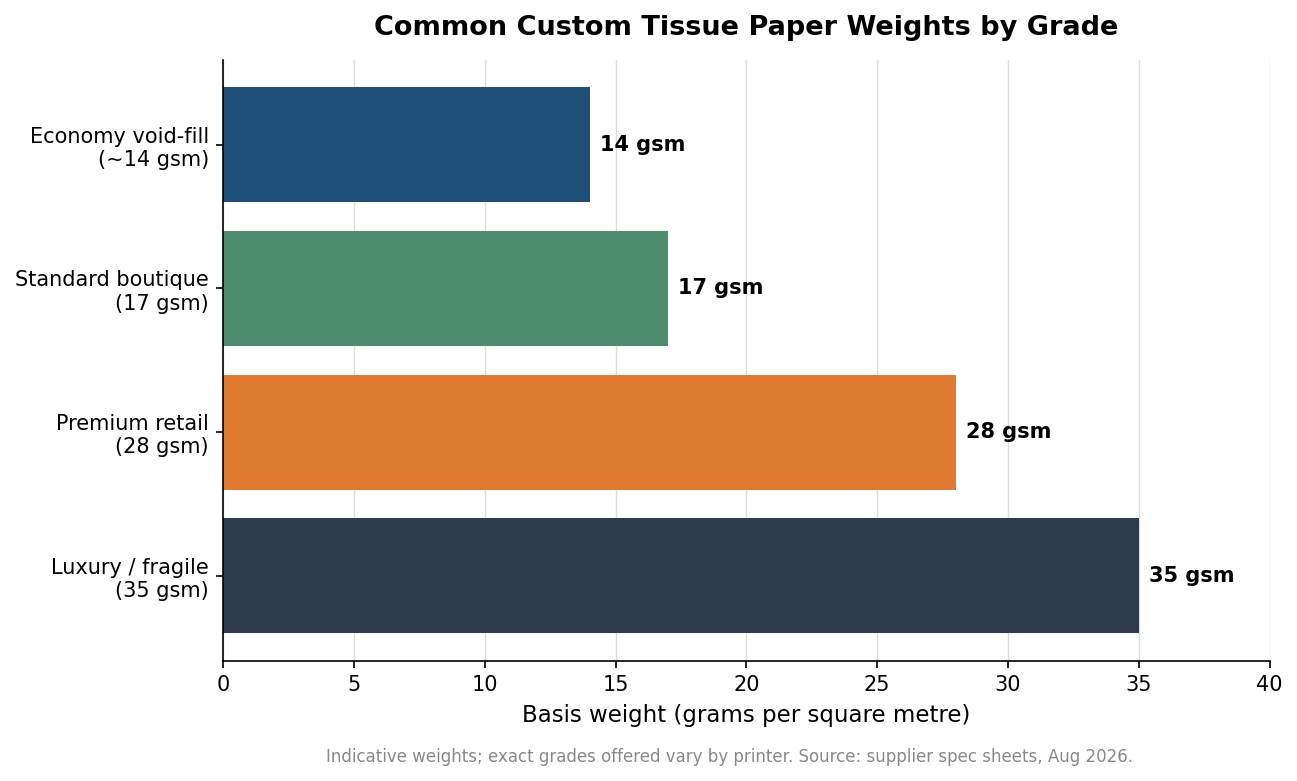
Around 14 GSM is economy, void-fill territory. It is thin, inexpensive, and fine for stuffing a shipping box, but it wrinkles easily and shows ink poorly, so it is a weak choice for anything a customer is meant to admire.
17 GSM is the workhorse of boutique retail. It is soft, lightweight, and noticeably translucent, which apparel, jewelry, and gift brands use deliberately: the customer sees a hint of the product through the sheet before they unwrap it. That translucency is also why 17 GSM flatters simple, single-color designs and repeating logo patterns more than dense full-bleed artwork.
28 GSM is the step up for premium ecommerce, shoes, and accessories. It is meaningfully heavier and more durable, with enough opacity to carry vibrant, multi-color, or detailed illustrations without the color washing out. If your brand palette is bold or your artwork is intricate, this is usually the floor.
35 GSM is the luxury and protective end. It feels closer to traditional wrapping paper, resists tearing, and gives the most solid, saturated print surface, which suits high-end presentation and fragile items that need a little cushioning. It costs more per sheet and is overkill for a lightweight product.
How weight changes the print
The interaction between weight and ink is where most disappointing reorders come from. On a light 17 GSM sheet, inks sit on a semi-transparent base, so a deep navy can read as a muted slate and white ink may look faintly grey against the product behind it. That is not a printing defect; it is the paper doing what light paper does. Printers work around it by matching to Pantone spot colors rather than trusting a screen preview, and by using soy-based inks that lay down cleanly on the thin stock. If you need punchy, reliable color, moving up to 28 or 35 GSM does more for you than any ink upgrade on a lighter sheet.
Method matters too. Digital printing lays down full CMYK, handles photographic and multi-color artwork, and carries low minimums, which is why short runs and complex designs tend to go digital. Flexographic printing uses spot-color plates and becomes cheaper per sheet at higher volumes, but each additional color adds a plate and cost, so it favors clean one- to three-color logos over gradients. Neither is universally better; the right pick follows your color count and quantity.
Matching sheet size to the product
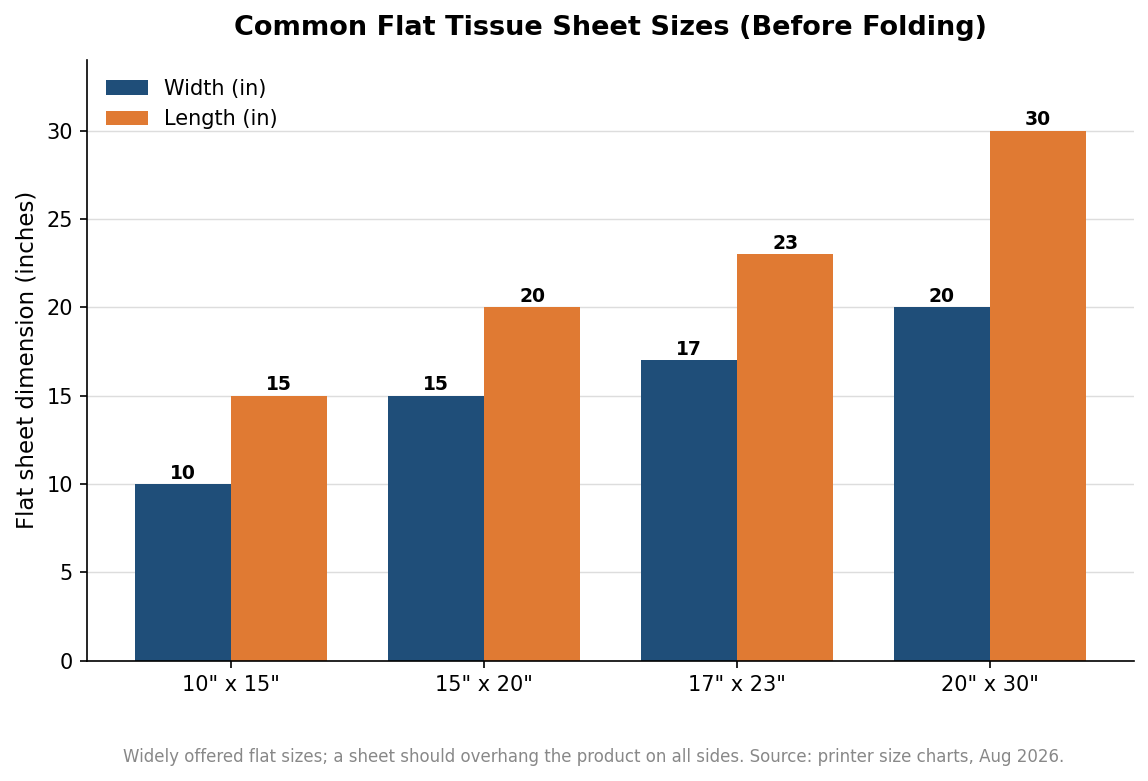
Flat tissue is sold in a handful of common pre-fold sizes, and the useful ones cluster around 10 by 15 inches, 15 by 20 inches, 17 by 23 inches, and 20 by 30 inches. The rule is simple: the flat sheet has to overhang your product on every side with enough margin to fold over and tuck, typically a few inches of slack, not a snug wrap. A folded garment that measures roughly 9 by 12 inches wants the 15 by 20 or 17 by 23 sheet, not the 10 by 15. When in doubt, size up; a sheet slightly too large folds down cleanly, while one slightly too small leaves the product peeking out.
Specifying weight without ordering the wrong thing
Three habits prevent the common mistakes. First, state GSM explicitly on your order and, if you were quoted in pounds, confirm the GSM equivalent in writing. Second, match weight to your artwork before you finalize: single-color and pattern work is happy at 17 GSM, while bold or multi-color designs generally need 28 GSM or heavier to look the way they do on screen. Third, ask for a physical proof or a small sample of the exact stock, because translucency and hand-feel simply do not come across in a digital mockup. Build in the lead time to do this: custom tissue commonly runs somewhere in the range of eight to twenty-plus business days in production depending on method and volume, plus a few days of transit, so a rushed order is exactly when the wrong-weight mistake slips through.
Weight is the least glamorous line on a tissue paper spec sheet and the one that quietly decides whether the unboxing feels considered or cheap. Choose it first, match your print and size to it, and confirm it with a sample before the full run. The artwork is the easy part; the paper it lands on is what your customer actually touches.
Leave a Reply