Category: Uncategorized

  • How Custom Tissue Paper Is Printed: Flexo, Digital, and Inks

    How Custom Tissue Paper Is Printed: Flexo, Digital, and Inks

    Tissue paper is one of the harder surfaces a brand will ever ask a printer to reproduce a logo on. It is thin, uncoated, and absorbent, so ink soaks into the fibers rather than sitting on top the way it does on a coated mailer box. That single property drives most of the decisions that follow: which press runs your job, how many colors you can realistically use, and whether the gradient that looks elegant in your file survives contact with the sheet. Here is how custom tissue actually gets printed, and what each method asks of your artwork.

    Flexography, the workhorse of tissue printing

    Most custom printed tissue is produced by flexography. A raised photopolymer plate is made for each color, an anilox roller meters a thin, even film of ink onto that plate, and a continuous web of tissue passes through one print station per color. The economics follow directly from that setup: every spot color needs its own plate and station, so the number of colors, not the number of sheets, is the main cost driver. Flexo is excellent at what tissue does best, namely crisp line work and solid single- or two-color fills, and it becomes very cost-effective once volume climbs high enough to spread the plate cost. Its limiting factor is registration. Tissue is light and slightly stretchy, so holding several colors in tight alignment for fine, interlocking detail is genuinely difficult, which is why the cleanest tissue designs tend to be bold rather than intricate.
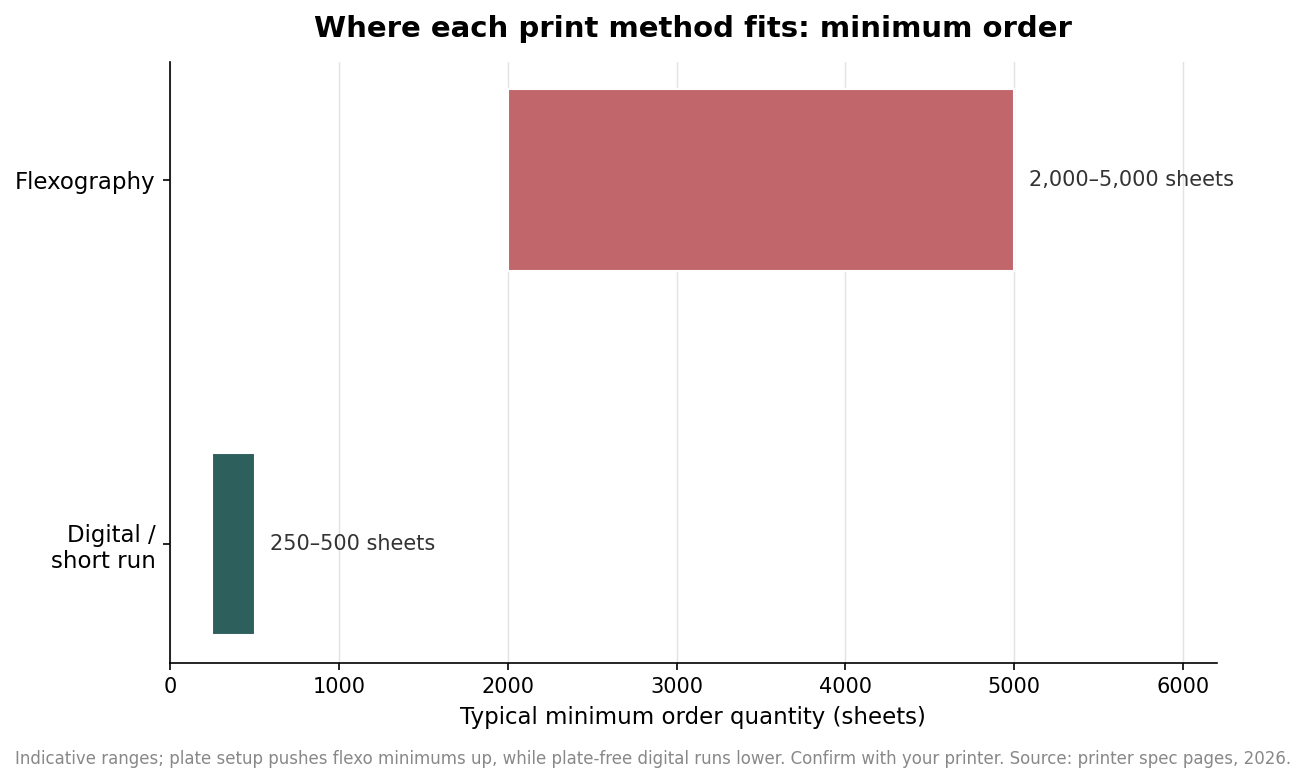
    Horizontal chart comparing typical minimum order quantities for digital short-run versus flexographic tissue printing
    Plate setup pushes flexo minimums into the thousands; plate-free digital runs far lower.

    Because plates carry a fixed setup cost, flexo minimums usually start in the low thousands of sheets. If your run is smaller than that, the plate charge dominates the per-unit price and a different method makes more sense.

    Digital and short-run routes

    Digital presses skip plates entirely, laying down a four-color process image directly from your file. That removes the setup barrier, which is why digital minimums can drop to a few hundred sheets and why it is the sensible choice for a boutique launch, a seasonal variant, or a test before you commit to a large flexo run. Digital also handles full-color and photographic artwork that spot-color flexo cannot. The tradeoffs are that per-sheet cost stays higher as volume grows, so digital rarely wins at scale, and process ink on absorbent tissue can look softer than a punchy flexo spot color. Treat digital as the short-run and full-color option, and flexo as the volume and brand-color option.

    The inks, and why opacity is the quiet variable

    Tissue is typically printed with water-based or soy-based inks that are low in volatile compounds and dry by absorption and evaporation rather than aggressive solvents. The variable most people overlook is opacity. On white tissue, standard inks read true. On a natural, kraft, or colored base, a translucent ink lets the sheet color show through and shifts the result, so a white logo or a light pastel needs a dedicated opaque white or a metallic ink, each of which is effectively its own color on the press. If the tissue will wrap food or cosmetics, say so up front and ask for inks rated for that contact, because not every stock ink qualifies.

    What reproduces well, and what fights the surface

    Design to the medium and tissue rewards you. Bold line art, a solid one- or two-color logo, a simple repeated monogram, and clean edge-to-edge patterns all reproduce beautifully. What struggles is anything that relies on fineness: small reversed-out type, delicate gradients, and photographic detail all tend to wick, fill in, or show through from the reverse of a thin sheet. You also choose a print style, and it affects both look and cost. A single spot placement logo uses the least ink and is the most economical; a scatter of small marks reads as branded without heavy coverage; and a full all-over or edge-to-edge print looks richest but uses the most ink and can lengthen drying. Heavier coverage on a heavier sheet also resists show-through, which is one reason weight and print design get specified together.
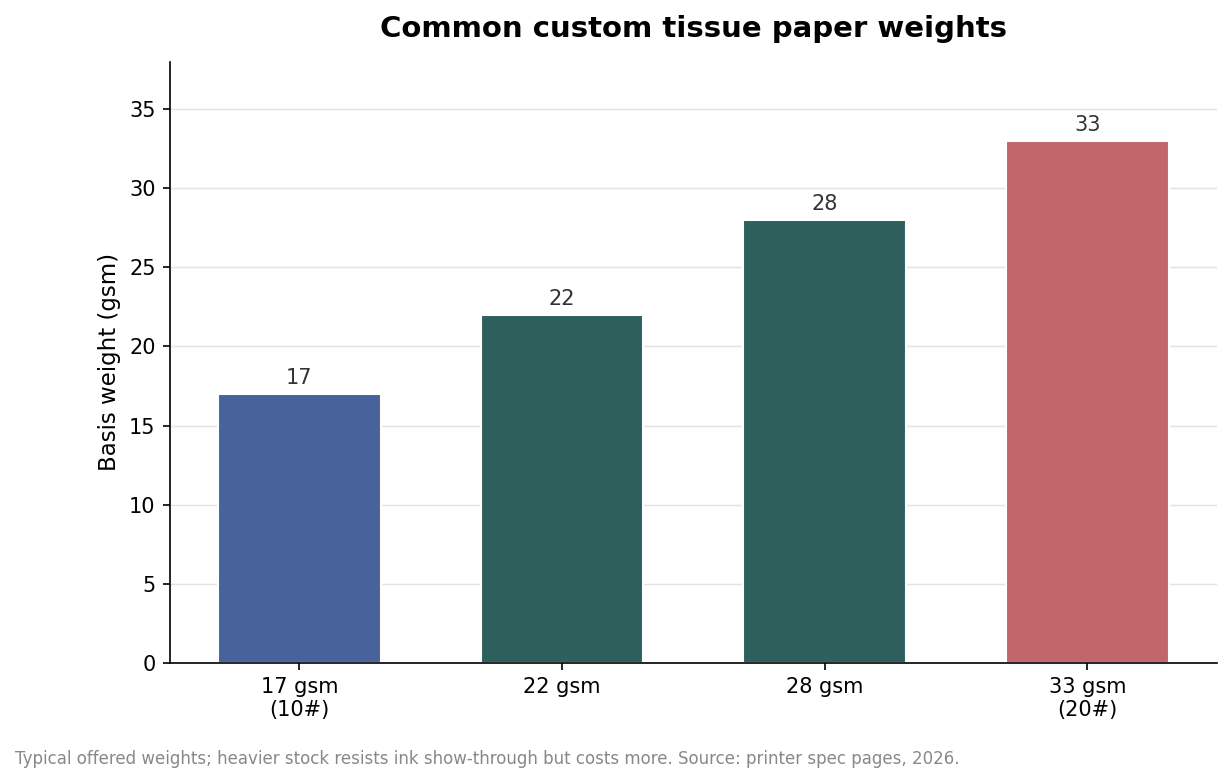
    Bar chart of common custom tissue paper basis weights from 17 to 33 gsm
    Heavier tissue resists ink show-through, which is why weight and print design are specified together.

    Matching color and proofing before the run

    Specify brand colors as Pantone spot values, ideally from the Solid Coated library, and expect the printer to mix inks to match rather than build the color from process. The catch is the substrate: a Pantone target that is accurate on white tissue will read differently on a natural or dyed sheet, so the only reliable check is a printed proof on your actual stock, not just a digital layout proof that shows position but not true ink-on-tissue. Flexo commonly supports up to around six spot colors, sheet sizes are widely customizable with twenty by thirty inches a common default, and recycled content up to one hundred percent with FSC certification is available on request from many suppliers. Plan on roughly four to six weeks from final artwork approval to delivery, and treat that as indicative rather than a promise until your printer confirms it against their current schedule.

    Match the method to the run and the artwork to the surface, and custom tissue is one of the highest-impact, lowest-cost pieces of branding a package can carry. Fight the surface with fine detail and heavy process art, and it becomes an expensive way to disappoint yourself.
  • Custom Tissue Paper Weight: A GSM Spec Comparison (17 vs 28 vs 35)

    Custom Tissue Paper Weight: A GSM Spec Comparison (17 vs 28 vs 35)

    Most people specifying custom tissue paper spend their energy on the artwork and the ink color, then treat the paper itself as an afterthought. That order is backwards. The single spec that most changes how a wrapped product looks and feels in the customer’s hands is basis weight, measured in grams per square metre (GSM). Weight decides how translucent the sheet is, how cleanly your print reads, and whether the tissue drapes softly or holds a crisp fold. Get it wrong and even a perfect logo lands on the wrong canvas.

    What GSM actually measures

    GSM is the weight of a one-square-metre sheet of the paper. A higher number means a denser, thicker, more opaque sheet; a lower number means a lighter, thinner, more see-through one. It is not a quality score. A 17 GSM tissue is not “worse” than a 35 GSM tissue, any more than a silk scarf is worse than a wool one. They are built for different jobs. You will occasionally see tissue quoted in pounds instead, such as a 10 lb versus an 18 lb stock, but the pound figure depends on an unstated basis-ream size and is far easier to misread, so ask your printer for the GSM number and specify against that.

    The weights you will actually choose between

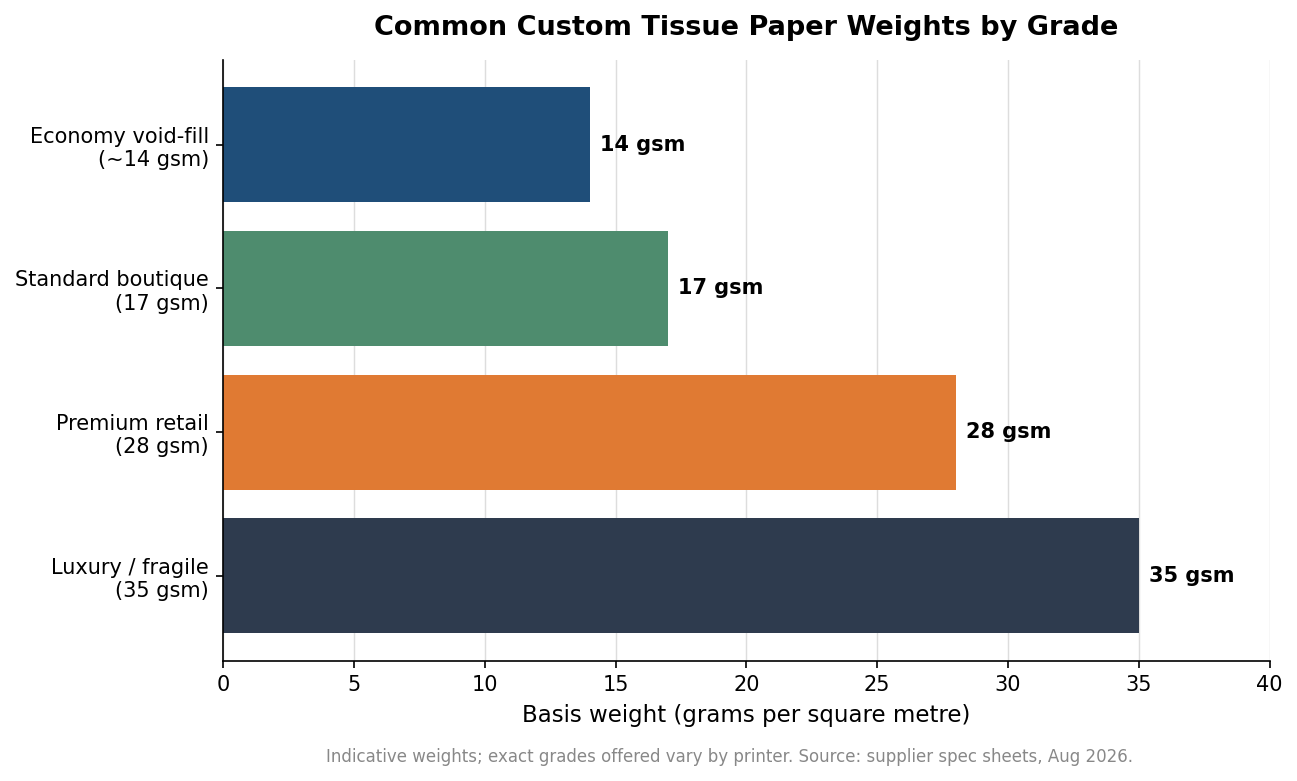
    Around 14 GSM is economy, void-fill territory. It is thin, inexpensive, and fine for stuffing a shipping box, but it wrinkles easily and shows ink poorly, so it is a weak choice for anything a customer is meant to admire.

    17 GSM is the workhorse of boutique retail. It is soft, lightweight, and noticeably translucent, which apparel, jewelry, and gift brands use deliberately: the customer sees a hint of the product through the sheet before they unwrap it. That translucency is also why 17 GSM flatters simple, single-color designs and repeating logo patterns more than dense full-bleed artwork.

    28 GSM is the step up for premium ecommerce, shoes, and accessories. It is meaningfully heavier and more durable, with enough opacity to carry vibrant, multi-color, or detailed illustrations without the color washing out. If your brand palette is bold or your artwork is intricate, this is usually the floor.

    35 GSM is the luxury and protective end. It feels closer to traditional wrapping paper, resists tearing, and gives the most solid, saturated print surface, which suits high-end presentation and fragile items that need a little cushioning. It costs more per sheet and is overkill for a lightweight product.

    Horizontal bar chart of common custom tissue paper weights: 14, 17, 28, and 35 GSM by grade
    Lighter weights suit soft, translucent wrapping; heavier weights carry bold, multi-color print.

    How weight changes the print

    The interaction between weight and ink is where most disappointing reorders come from. On a light 17 GSM sheet, inks sit on a semi-transparent base, so a deep navy can read as a muted slate and white ink may look faintly grey against the product behind it. That is not a printing defect; it is the paper doing what light paper does. Printers work around it by matching to Pantone spot colors rather than trusting a screen preview, and by using soy-based inks that lay down cleanly on the thin stock. If you need punchy, reliable color, moving up to 28 or 35 GSM does more for you than any ink upgrade on a lighter sheet.

    Method matters too. Digital printing lays down full CMYK, handles photographic and multi-color artwork, and carries low minimums, which is why short runs and complex designs tend to go digital. Flexographic printing uses spot-color plates and becomes cheaper per sheet at higher volumes, but each additional color adds a plate and cost, so it favors clean one- to three-color logos over gradients. Neither is universally better; the right pick follows your color count and quantity.

    Matching sheet size to the product

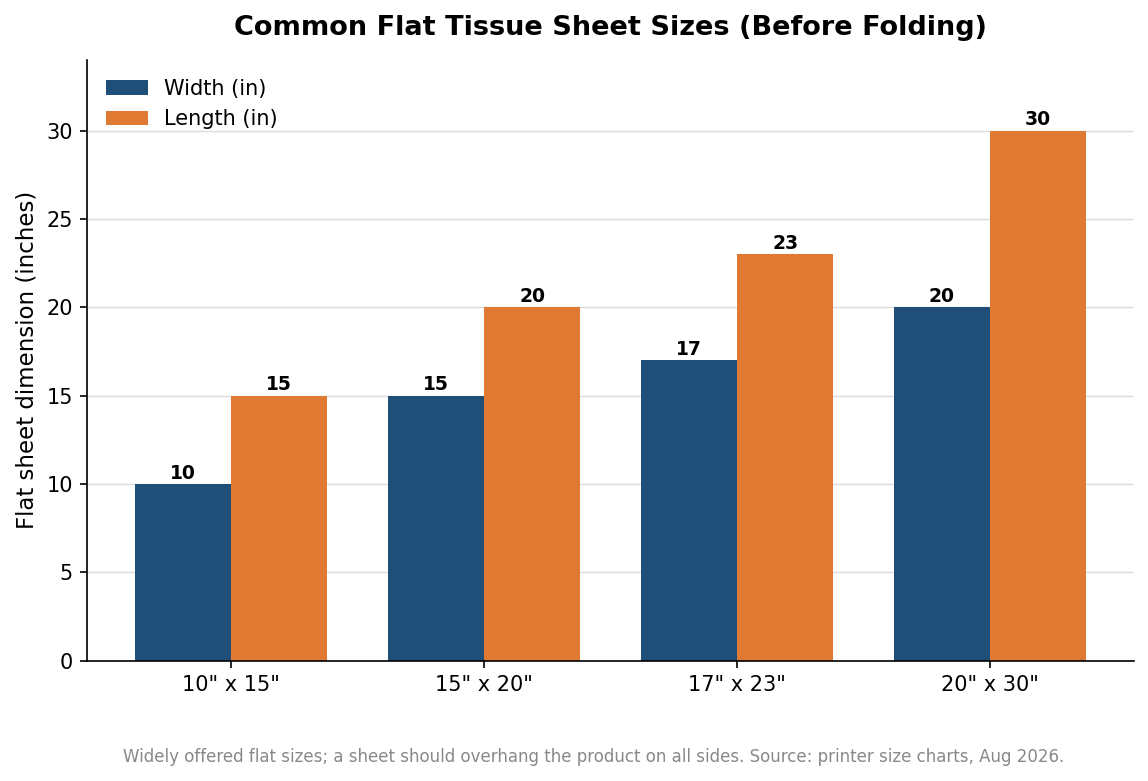
    Flat tissue is sold in a handful of common pre-fold sizes, and the useful ones cluster around 10 by 15 inches, 15 by 20 inches, 17 by 23 inches, and 20 by 30 inches. The rule is simple: the flat sheet has to overhang your product on every side with enough margin to fold over and tuck, typically a few inches of slack, not a snug wrap. A folded garment that measures roughly 9 by 12 inches wants the 15 by 20 or 17 by 23 sheet, not the 10 by 15. When in doubt, size up; a sheet slightly too large folds down cleanly, while one slightly too small leaves the product peeking out.

    Grouped bar chart of common flat tissue sheet sizes showing width and length in inches
    Common pre-fold sheet sizes; pick one that overhangs the product on every side.

    Specifying weight without ordering the wrong thing

    Three habits prevent the common mistakes. First, state GSM explicitly on your order and, if you were quoted in pounds, confirm the GSM equivalent in writing. Second, match weight to your artwork before you finalize: single-color and pattern work is happy at 17 GSM, while bold or multi-color designs generally need 28 GSM or heavier to look the way they do on screen. Third, ask for a physical proof or a small sample of the exact stock, because translucency and hand-feel simply do not come across in a digital mockup. Build in the lead time to do this: custom tissue commonly runs somewhere in the range of eight to twenty-plus business days in production depending on method and volume, plus a few days of transit, so a rushed order is exactly when the wrong-weight mistake slips through.

    Weight is the least glamorous line on a tissue paper spec sheet and the one that quietly decides whether the unboxing feels considered or cheap. Choose it first, match your print and size to it, and confirm it with a sample before the full run. The artwork is the easy part; the paper it lands on is what your customer actually touches.

  • Sustainable Custom Tissue Paper: Recycled Content, FSC, Inks, and What the Labels Mean

    Sustainable Custom Tissue Paper: Recycled Content, FSC, Inks, and What the Labels Mean

    Custom tissue paper is often the first thing a customer touches when they open a box, and increasingly it is where a brand signals whether its packaging is genuinely responsible or just wearing the color green. The trouble is that the sustainability language on tissue is loose, and a cheerful claim can hide a thin one. This guide translates the terms you will see on a quote, from recycled content and FSC to acid-free and soy ink, and connects them to the practical specs, weight, size, and cost, so you can order tissue that backs up the story on the label.

    What “eco-friendly” actually has to prove

    Tissue paper is a single, lightweight sheet, so its environmental footprint comes down to a few concrete questions: where the fiber came from, whether the forest source is certified, what the ink is made of, and whether the finished sheet can actually be recycled or composted after use. A product that answers all four with specifics is doing real work; one that simply says “eco-friendly” or “green” without naming a percentage, a certification, or an ink type is leaving you to assume. Treat the vague version as a prompt to ask for the details rather than as proof, because every reputable supplier can produce them.

    Recycled content, and how to read the claim

    Stacked bar chart comparing recycled versus virgin fiber content in two tissue paper claims
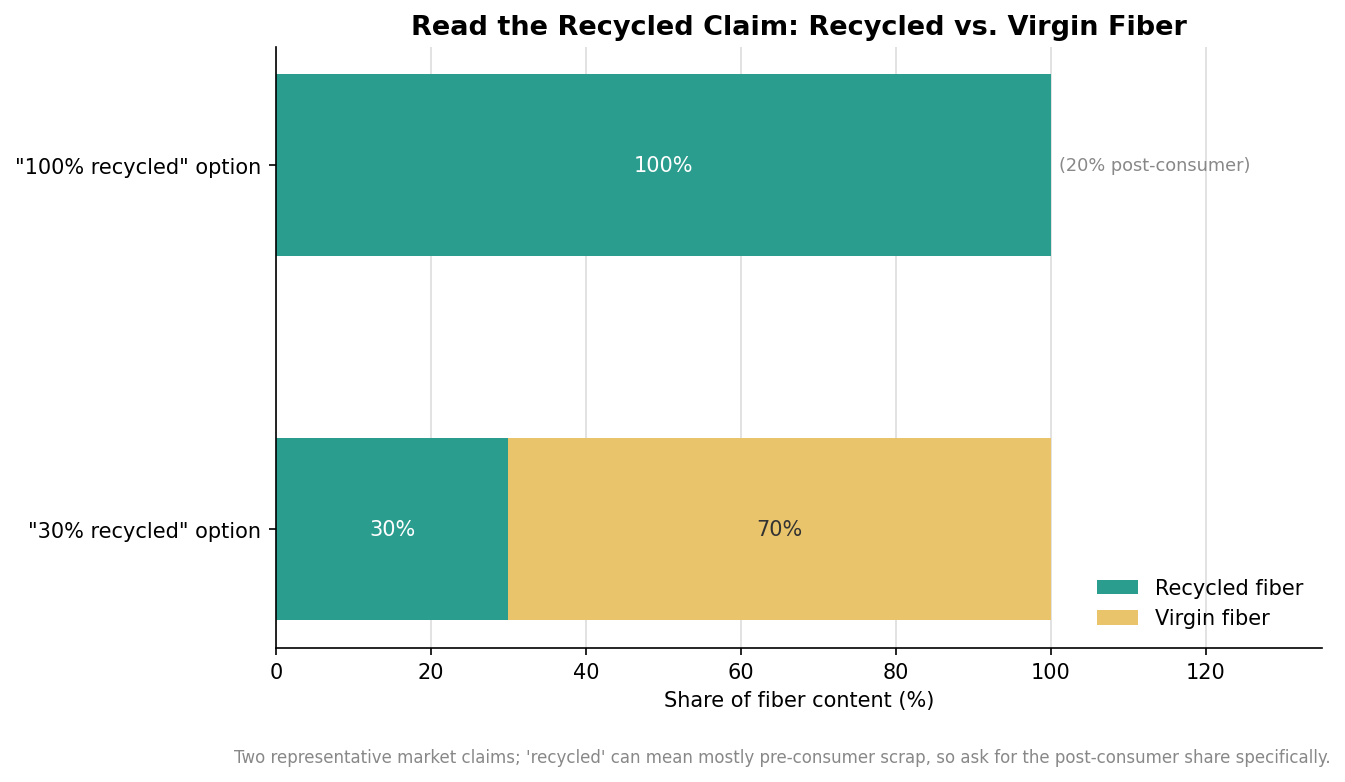
    A recycled claim can be mostly pre-consumer scrap, so the number that matters is the post-consumer share.

    Recycled content is where most of the confusion lives, because “recycled” bundles two very different things. Post-consumer fiber comes from paper that a person used and discarded, so recycling it genuinely diverts waste. Pre-consumer fiber is manufacturing scrap, such as printing offcuts, that never left the factory; using it is good practice but it is not the same as capturing waste from the world. A sheet marketed as “100% recycled” can still be mostly pre-consumer, with a post-consumer share as low as 20 percent, while another product may be 30 percent recycled and 70 percent virgin. Neither is wrong, but they are not equivalent, so the number to ask for is the post-consumer percentage specifically rather than the headline recycled figure.

    FSC, acid-free, and chlorine-free, decoded

    A handful of certifications carry real meaning. FSC certification (you will often see “FSC Mix”) tells you the virgin fiber in the sheet is traced to responsibly managed forests through a chain-of-custody audit, which is the credential to look for whenever a product is not fully post-consumer. Acid-free, or pH neutral, means the paper will not yellow or chemically damage what it wraps over time; that matters for garments, photographs, and anything a customer may keep the tissue with, and it is standard on quality tissue rather than a premium extra. Processed chlorine free indicates the pulp was bleached without elemental chlorine, avoiding the more harmful byproducts of older bleaching. Finally, watch the finish: glitter, foil stamping, and plastic lamination all compromise recyclability and compostability, so if curbside recyclability is part of your pitch, keep the sheet free of those add-ons.

    Inks: soy, water-based, and newer options

    The ink is a small part of the sheet by weight but a large part of the sustainability claim. Soy-based inks are made from a renewable crop rather than petroleum and are widely used on custom tissue; water-based inks carry low solvent content and hit custom Pantone (PMS) colors cleanly, which is how printers match a brand color. Some mills now offer newer alternatives such as algae-derived inks marketed as carbon-negative. Whatever the chemistry, tissue is printed with the design pressed onto the sheet, and the paper weight you choose affects how the ink reads. A single brand color on a light sheet is the most economical setup; if you want two or more colors or a design that needs to look saturated, plan on the heavier weight so the color has something to sit on.

    Weight, size, and what it costs

    Line chart showing custom tissue paper price per sheet falling as order quantity rises
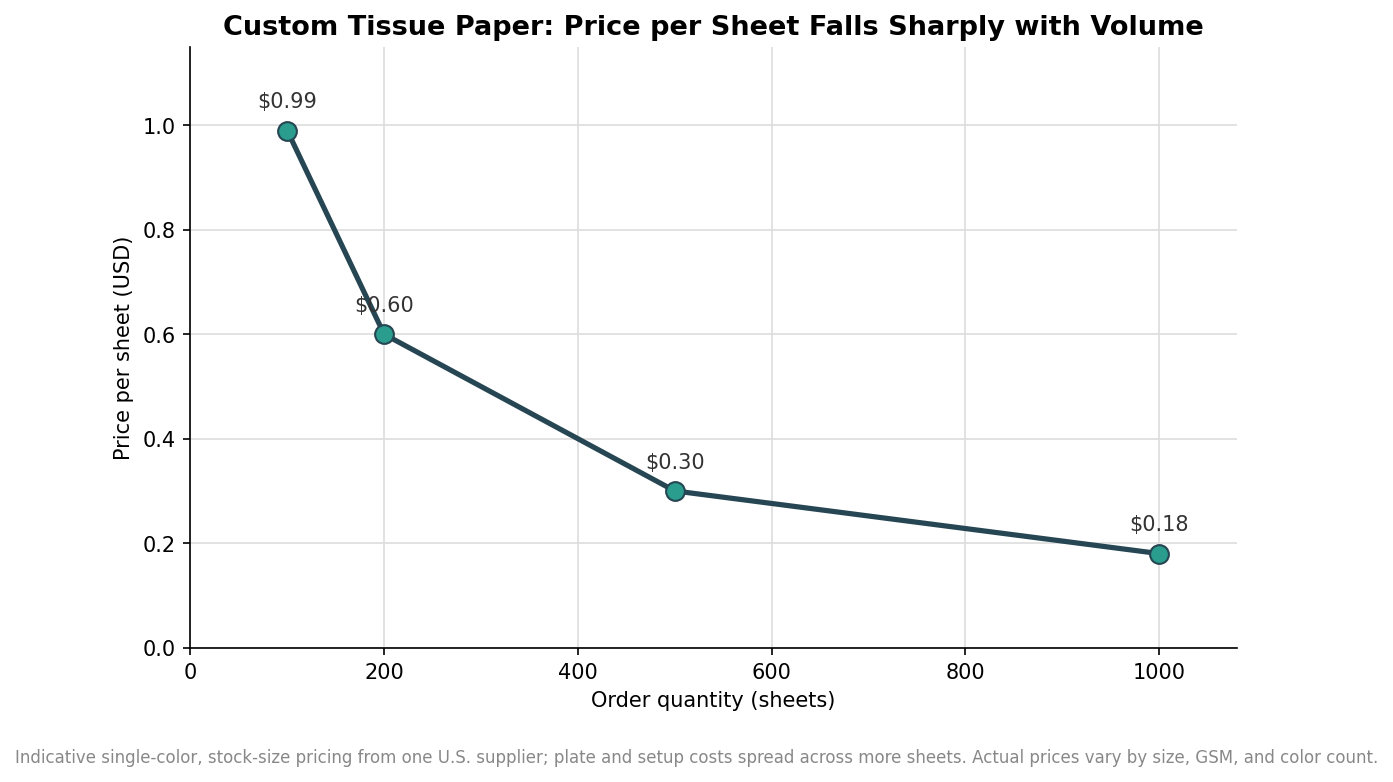
    Plate and setup costs spread across the run, so per-sheet cost drops steeply between 100 and 1,000 sheets.

    Tissue weight is measured in GSM, grams per square meter. A 17 GSM sheet, roughly an 11-pound basis weight, is light and slightly sheer, so a product shows through it for a soft, layered reveal; it prints one color beautifully and keeps cost down. A 28 to 30 GSM sheet, around a 20-pound basis weight, is more opaque and gives multi-color and darker designs their fullest vibrancy, at a modest cost premium. Lower GSM is not lower quality; it is a different look, so match the weight to the effect you want. Standard sheet sizes cluster around 15 by 20 inches for smaller items and about 20 by 30 inches for larger ones, with custom sizes available; pick the size to your most common product so you are not wrapping a small item in a wasteful sheet.

    On cost and timing, tissue is a classic economy-of-scale product because the plate and setup are a fixed cost spread across the run. Indicative single-color pricing from one U.S. supplier runs about $0.99 per sheet at 100 sheets, $0.60 at 200, $0.30 at 500, and $0.18 at 1,000, so the per-sheet price falls by more than five times as you move from the smallest run to a thousand sheets; treat those as ballpark figures rather than a quote, since size, GSM, and color count all move the number. Minimums commonly start around 100 to 250 sheets, and production typically runs two to three weeks after you approve the mock-up, with rush options usually available. Decide the post-consumer content and certifications first, choose the ink and weight to fit your design, then size the run to a quantity where the per-sheet cost makes sense, and you will have tissue that is both convincing on sustainability and sensible on budget.

  • Five Costly Mistakes When Ordering Custom Tissue Paper

    Five Costly Mistakes When Ordering Custom Tissue Paper

    Custom tissue paper looks like the simplest line on a packaging order, which is exactly why it goes wrong so predictably. It is thin, cheap per sheet, and easy to treat as an afterthought once the boxes and labels are sorted. Then the proof comes back with the logo bleeding through, or the sheets are too small to wrap the product, or a silk garment yellows in storage, and a small item becomes a reprint. The mistakes below are the ones that recur, and every one is avoidable at the specification stage.

    Ordering tissue too thin to carry the print

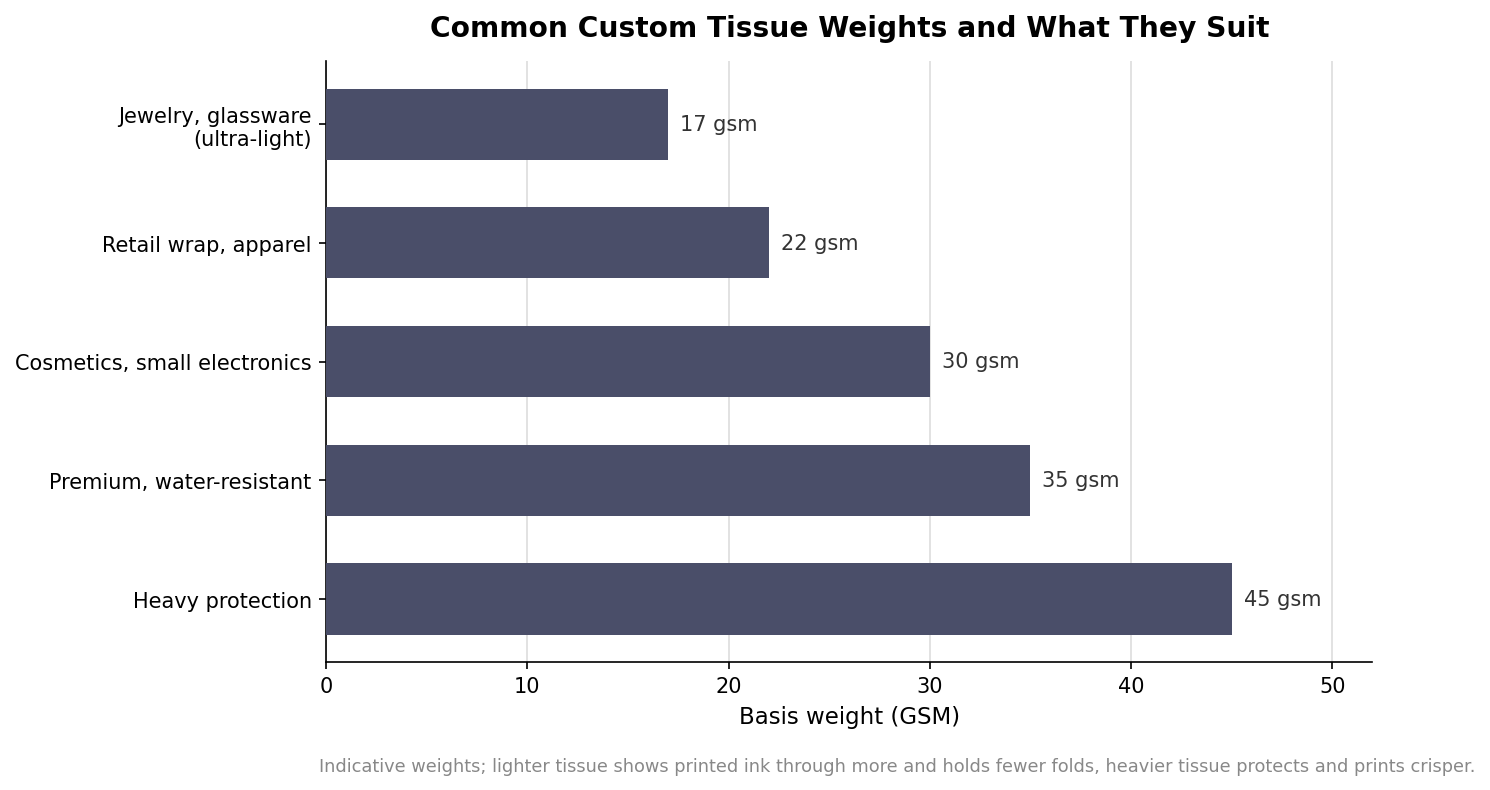
    Weight, measured in GSM, is the first thing buyers underestimate. Ultra-light 17 gsm tissue is genuinely useful for jewelry, glassware, and delicate confetti, but it absorbs a lot of ink and lets a dark or heavy design show through to the other side, and it creases and tears sooner. Stepping up to 22 gsm is the quiet default for retail wrapping and apparel because it prints more crisply and survives more folds before it fails. When the artwork is dark, full-coverage, or double-sided, or when the tissue also has to protect a harder product, heavier stock from 30 gsm upward earns its cost by resisting show-through and holding shape. Match the weight to both the print and the product, not to the lowest sheet price.

    Horizontal bar chart of common custom tissue paper weights in GSM and their typical uses
    Indicative tissue weights by use; lighter stock shows ink through more and creases sooner.

    Designing for coverage the print method cannot deliver cheaply

    Tissue is decorated one of two ways, and picking the wrong one for your art inflates the bill. Flexographic printing is the volume workhorse, laying down one or two spot colors, often soy-based, in a repeating pattern across the sheet. It is economical at scale and ideal for a logo or a simple repeat, but each additional spot color and any tight registration adds cost and risk on thin, stretchy stock. Digital printing handles full-color, photographic, or highly detailed art and short runs without a plate, at a higher per-sheet price. The common mistake is designing a complex, many-color, edge-to-edge pattern and then asking for it flexo-printed at a budget rate. Decide the method first, then design within its strengths: keep flexo art to a clean one or two colors, and reserve dense multicolor work for digital.

    Skipping acid-free tissue when the product needs it

    Regular tissue is mildly acidic, and over months that acidity can yellow and degrade what it touches. Acid-free, pH-neutral tissue is the fix, and it matters most for exactly the products boutiques care about: silk and fine apparel, photographs and printed keepsakes, jewelry, and anything meant to be stored rather than unwrapped the same day. It is the reason luxury fashion houses and even museums default to acid-free for long-term contact, where ordinary tissue can leave visible discoloration on light fabrics within a season or two of storage. If your tissue is purely a one-time unboxing flourish that the customer discards, standard stock is fine; if it stays wrapped around a garment or heirloom, specify acid-free and treat it as protection rather than decoration.

    Guessing the sheet size against the product

    A sheet that is a few inches short is worse than useless because it cannot actually enclose the product. Tissue is commonly cut to sizes in the range of 15 by 20 inches or 20 by 30 inches, and many printers will also cut a custom size if your product falls between the standards. The right choice depends on the footprint you need to wrap and how much overlap you want for a clean fold. Measure the largest item the sheet must cover and add enough margin to fold over and tuck, rather than ordering a standard size and hoping. A sheet that is slightly generous drapes and folds elegantly; one that is slightly small looks skimpy and leaves the product peeking out, which undercuts the premium feel the tissue was supposed to create.

    Underestimating minimums, lead time, and fresh-ink rub

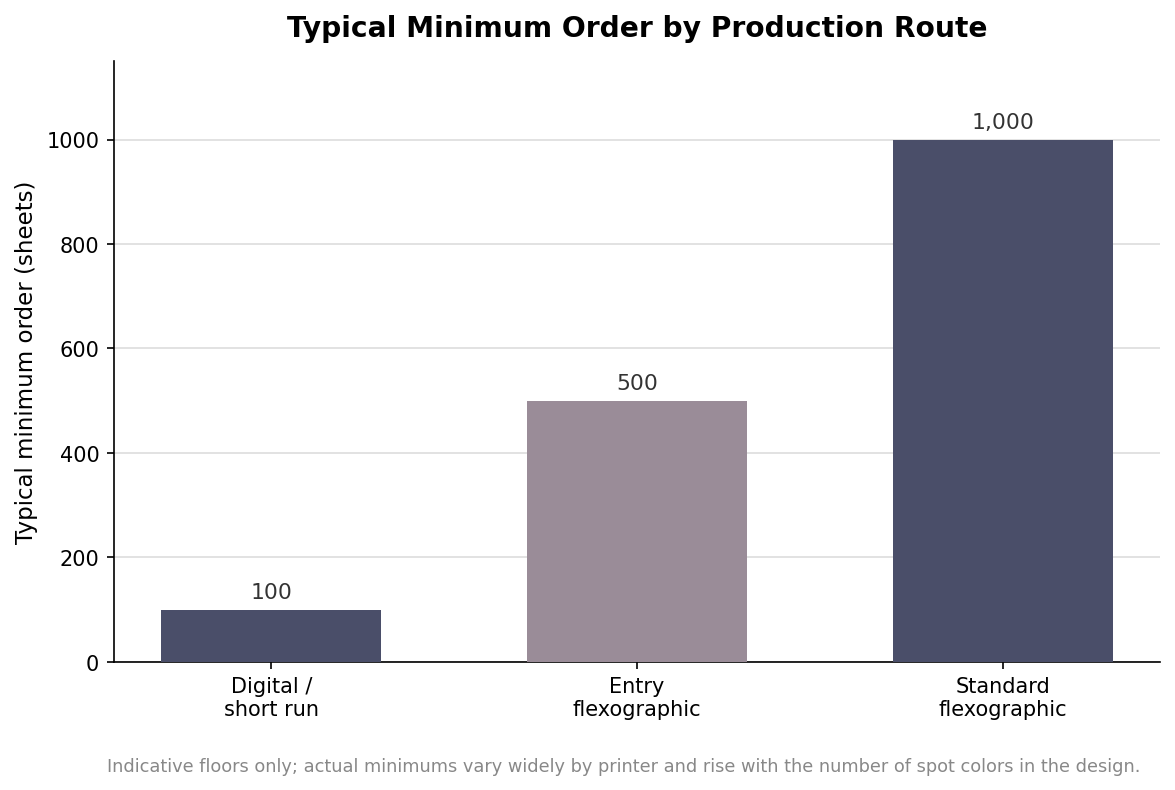
    Minimum order quantities swing widely, and buyers who assume a small trial run is available are often surprised. Short-run digital printing can start around 100 sheets, while flexographic production commonly sets its floor near 500 to 1,000 sheets and higher as spot colors are added, because the plates and setup only pay off across volume. Production itself is usually quick, on the order of 7 to 10 business days, but that clock starts after you approve a proof and does not include shipping. Two smaller traps hide in the timeline. Freshly printed tissue needs its ink to cure, and rushing folding or packing can cause set-off, where the design rubs onto the facing sheet or the product. And a rejected proof restarts the schedule, so approve color and placement carefully the first time. Order earlier than feels necessary, confirm the minimum before you fall in love with a design, and build in the proof round. It also pays to ask for pricing at two quantities, since the per-sheet cost often drops sharply once you clear the next volume break, and a modest bump in order size can lower your unit price more than it raises the total.

    Bar chart of typical minimum order quantities for digital versus flexographic tissue printing
    Indicative minimum-order floors by production route; flexographic runs demand more volume.

    Getting it right in one pass

    None of these mistakes require expertise to avoid, only sequence. Choose the weight for your print and product, pick the print method before finalizing the art, specify acid-free whenever the tissue will sit against something valuable, size the sheet to the item with margin to fold, and confirm the minimum and lead time before you commit. Handled in that order, custom tissue does what it is supposed to do, which is make an ordinary box feel deliberately, quietly premium the moment it opens.