Custom tissue paper is often the first thing a customer touches when they open a box, and increasingly it is where a brand signals whether its packaging is genuinely responsible or just wearing the color green. The trouble is that the sustainability language on tissue is loose, and a cheerful claim can hide a thin one. This guide translates the terms you will see on a quote, from recycled content and FSC to acid-free and soy ink, and connects them to the practical specs, weight, size, and cost, so you can order tissue that backs up the story on the label.
What “eco-friendly” actually has to prove
Tissue paper is a single, lightweight sheet, so its environmental footprint comes down to a few concrete questions: where the fiber came from, whether the forest source is certified, what the ink is made of, and whether the finished sheet can actually be recycled or composted after use. A product that answers all four with specifics is doing real work; one that simply says “eco-friendly” or “green” without naming a percentage, a certification, or an ink type is leaving you to assume. Treat the vague version as a prompt to ask for the details rather than as proof, because every reputable supplier can produce them.
Recycled content, and how to read the claim
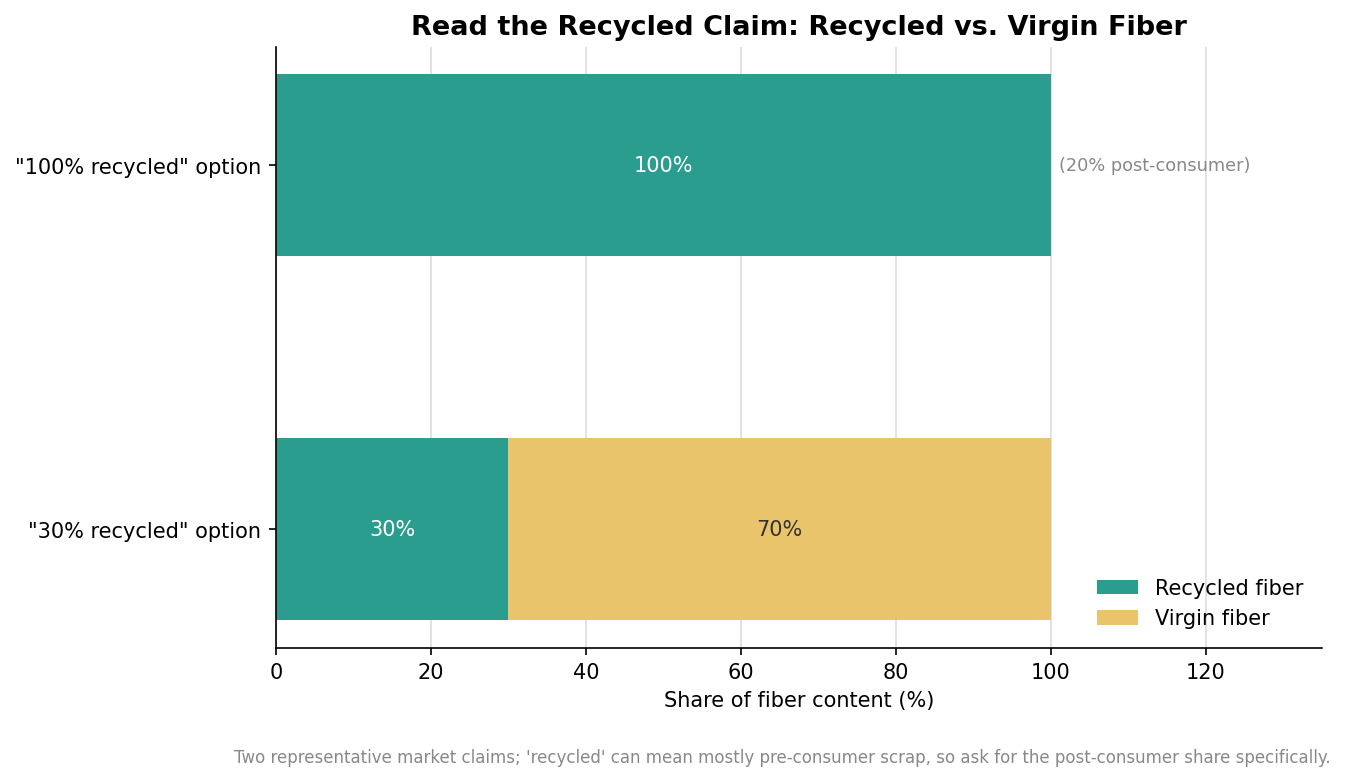
Recycled content is where most of the confusion lives, because “recycled” bundles two very different things. Post-consumer fiber comes from paper that a person used and discarded, so recycling it genuinely diverts waste. Pre-consumer fiber is manufacturing scrap, such as printing offcuts, that never left the factory; using it is good practice but it is not the same as capturing waste from the world. A sheet marketed as “100% recycled” can still be mostly pre-consumer, with a post-consumer share as low as 20 percent, while another product may be 30 percent recycled and 70 percent virgin. Neither is wrong, but they are not equivalent, so the number to ask for is the post-consumer percentage specifically rather than the headline recycled figure.
FSC, acid-free, and chlorine-free, decoded
A handful of certifications carry real meaning. FSC certification (you will often see “FSC Mix”) tells you the virgin fiber in the sheet is traced to responsibly managed forests through a chain-of-custody audit, which is the credential to look for whenever a product is not fully post-consumer. Acid-free, or pH neutral, means the paper will not yellow or chemically damage what it wraps over time; that matters for garments, photographs, and anything a customer may keep the tissue with, and it is standard on quality tissue rather than a premium extra. Processed chlorine free indicates the pulp was bleached without elemental chlorine, avoiding the more harmful byproducts of older bleaching. Finally, watch the finish: glitter, foil stamping, and plastic lamination all compromise recyclability and compostability, so if curbside recyclability is part of your pitch, keep the sheet free of those add-ons.
Inks: soy, water-based, and newer options
The ink is a small part of the sheet by weight but a large part of the sustainability claim. Soy-based inks are made from a renewable crop rather than petroleum and are widely used on custom tissue; water-based inks carry low solvent content and hit custom Pantone (PMS) colors cleanly, which is how printers match a brand color. Some mills now offer newer alternatives such as algae-derived inks marketed as carbon-negative. Whatever the chemistry, tissue is printed with the design pressed onto the sheet, and the paper weight you choose affects how the ink reads. A single brand color on a light sheet is the most economical setup; if you want two or more colors or a design that needs to look saturated, plan on the heavier weight so the color has something to sit on.
Weight, size, and what it costs
Tissue weight is measured in GSM, grams per square meter. A 17 GSM sheet, roughly an 11-pound basis weight, is light and slightly sheer, so a product shows through it for a soft, layered reveal; it prints one color beautifully and keeps cost down. A 28 to 30 GSM sheet, around a 20-pound basis weight, is more opaque and gives multi-color and darker designs their fullest vibrancy, at a modest cost premium. Lower GSM is not lower quality; it is a different look, so match the weight to the effect you want. Standard sheet sizes cluster around 15 by 20 inches for smaller items and about 20 by 30 inches for larger ones, with custom sizes available; pick the size to your most common product so you are not wrapping a small item in a wasteful sheet.
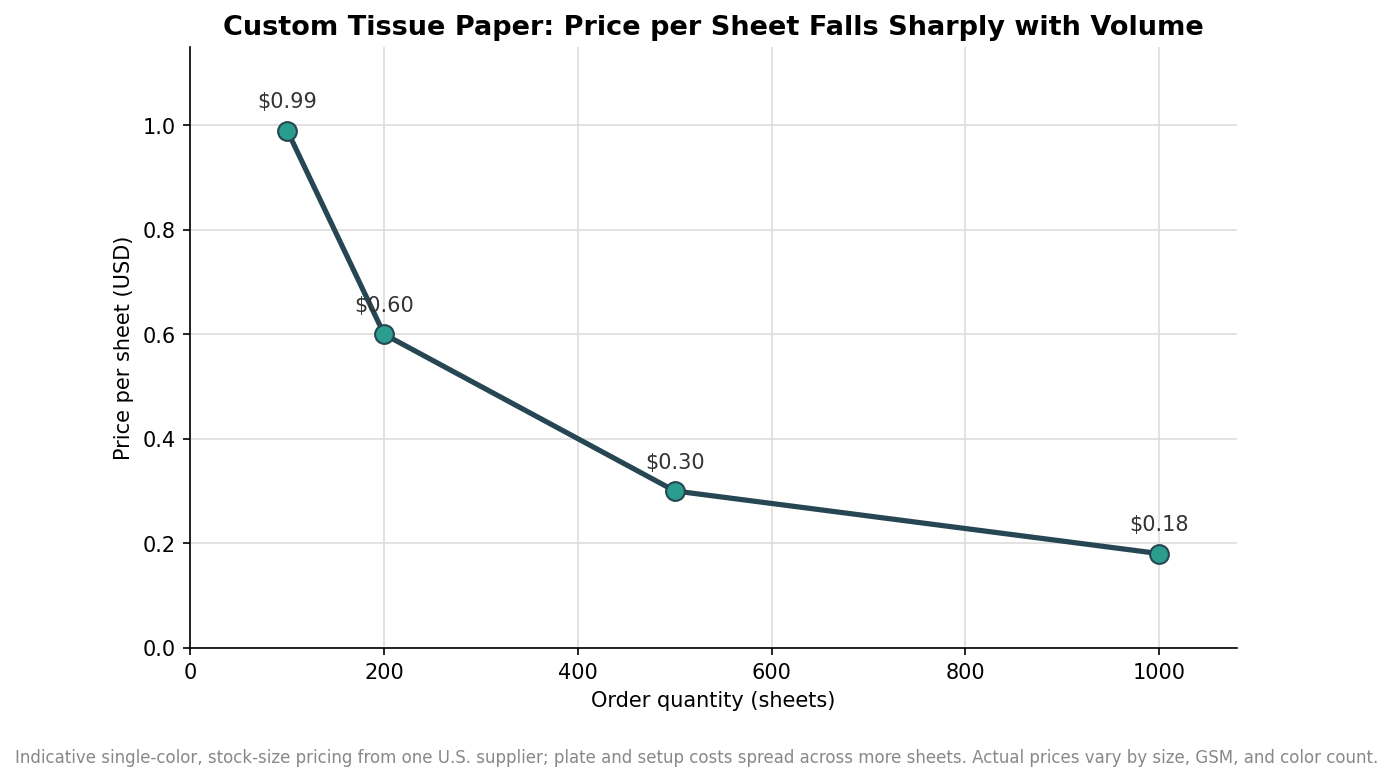
On cost and timing, tissue is a classic economy-of-scale product because the plate and setup are a fixed cost spread across the run. Indicative single-color pricing from one U.S. supplier runs about $0.99 per sheet at 100 sheets, $0.60 at 200, $0.30 at 500, and $0.18 at 1,000, so the per-sheet price falls by more than five times as you move from the smallest run to a thousand sheets; treat those as ballpark figures rather than a quote, since size, GSM, and color count all move the number. Minimums commonly start around 100 to 250 sheets, and production typically runs two to three weeks after you approve the mock-up, with rush options usually available. Decide the post-consumer content and certifications first, choose the ink and weight to fit your design, then size the run to a quantity where the per-sheet cost makes sense, and you will have tissue that is both convincing on sustainability and sensible on budget.
Leave a Reply